PARADIM Highlight #114—In-House Research (2025)
T.M. McQueen (Johns Hopkins) L.F. Kourkoutis and T.A. Arias (Cornell University)
Misfit chalcogenides offer the opportunity of combining magnetism and superconductivity. The structure of the misfits consists of transition metal dichalcogenides (TMDs) stacked with alternating layers of a rare-earth rock salt. The TMDs can host many interesting electronic phases which can be heavily doped by the neighboring rock salt layers. Despite studies since the 1970, the extend of the charge transfer remained poorly understood.
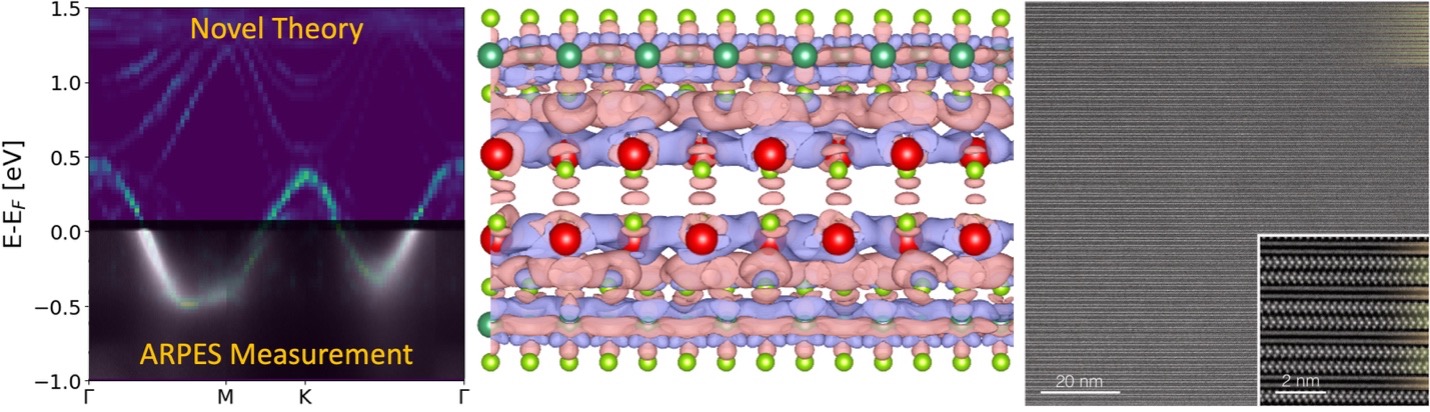
Figure 1: (Left) Overlay of measured ARPES data with new theoretical predictions, showing excellent agreement. (Center) Electron density change upon interaction between LaSe and NbSe2 layers showing the formation of interlayer covalent bonds and intralayer electron re-arrangement rather than the previously assumed net-interlayer charge transfer. Regions colored red (blue) indicate gain (loss) of electrons. (Right) Scanning transmission electron microscopy reveals consistent layered structure across length scales. Orange and green stripes indicate LaSe and NbSe2 layers.
Here, PARADIM’s In-House Research Team applied their newly developed ab initio theoretical framework for mismatched interfaces (MINT) that enables accurate calculations of the electronic and vibrational properties of mismatched layered quantum materials. Applied to the misfit rock-salt/TMD heterostructures, the team shows that the large effective doping in the TMD layers arises from electron rearrangement within each layer, and not from net interlayer charge transfer, as previously assumed. ARPES measurements demonstrate mutual consistency of theory and experiment on PARADIM-grown high-quality bulk single crystals. The generality of our new method and insight into the nature of effective doping guide both theory and experimental efforts to create layered quantum materials with optimal properties for novel electronics and beyond.
Members of the PARADIM In-House Research Team developed a new ab initio theoretical framework called MINT—Mismatched Interface Theory—that enables accurate calculations of both the electronic and vibrational properties of mismatched layered materials (prevalent in quantum and electronic devices), something not achievable by previous methods. We demonstrate excellent mutual consistency between our new method and both newly acquired and existing experimental data, providing a strong validation of the method.
Using this framework, we resolve a longstanding misconception in the literature on misfit rock-salt/TMD heterostructures. We show that the large observed doping of the TMD layers does not arise from net interlayer charge transfer, as previously assumed, but instead arises from a rearrangement of electrons within each individual layer.
The method introduced in this paper is broadly applicable to any incommensurate layered material, enabling first-principles studies of properties such as superconductivity, thermoelectric transport, and heat transport that were previously inaccessible, limiting our ability to build quantum electronic devices by design. The insight that large effective doping can arise without net interlayer charge transfer will help guide researchers in developing more effective strategies for engineering layered systems with optimized electronic and thermal behavior.
Here, all four parts of PARADIM working in unison, combining bulk crystal growth, characterization via electron microscopy and in-situ ARPES measurements, with the new technique developments in the theory facility.
The software codes and as well as a tutorial for the mismatched interface theory (MINT) and related packages are available through PARADIM at DOI: 10.34863/seqm-4p70.
D. Niedzielski, B.D. Faeth, B.H. Goodge, M. Sinha, T.M. McQueen, L.F. Kourkoutis, and T.A. Arias, Unmasking Charge Transfer in the Misfits: ARPES and Ab Initio Prediction of Electronic Structure in Layered Incommensurate Systems without Artificial Strain, Phys. Rev. Lett. 135, 206202 (2025).
This work made use of the theory, thin film growth, electron microscopy, and bulk crystal growth facilities of the Platform for the Accelerated Realization, Analysis, and Discovery of Interface Materials (PARADIM), which are supported by the National Science Foundation under Cooperative Agreement No. DMR-2039380. D. Niedzielski and B. H. Goodge acknowledge support under this same agreement, and L. F. Kourkoutis and T. A. Arias acknowledge partial support as well.