PARADIM Highlight #115—External User Project (2025)
V. Gopalan, V.A. Stoica, L.-Q. Chen (all Penn State), and D.G. Schlom (Cornell)
The search for thin-film electro-optic materials that can retain superior performance at cryogenic temperatures has become critical for quantum computing. Barium titanate (BaTiO3) thin films show large linear electro-optic coefficients in the tetragonal phase at room temperature, but less so in the rhombohedral phase at low temperatures. Manipulating such phase transformations and retaining superior electro-optic properties down to liquid helium temperature is of immense technological interest.
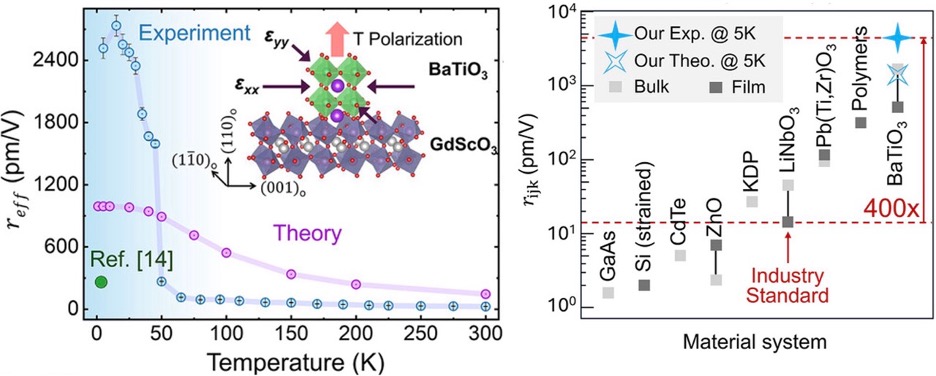
Figure 1: (Left) Comparison between experiment (blue) and phase-field simulation (purple) of the effective electro-optic coefficient of a BaTiO3 film strained to an underlying GdScO3 substrate (–1% biaxial compressive strain) vs. temperature. The best prior cryogenic coefficient reported is also shown (green). (Right) Comparison between the maximum electro-optic response obtained in this work and several other benchmark materials.
Utilizing the thermodynamic theory of optical properties, users of PARADIM theorized that a large low-temperature electro-optic response should occur in the metastable monoclinic phase of BaTiO3. At the Platform, a strain-tuned BaTiO3 thin film was made by a new method developed by PARADIM’s In-House team. The user then measured the linear electro-optic coefficient to be 2516 pm/V at 5 K, which is an order of magnitude above the best prior reported performance. In contrast to conventional BaTiO3 films, where the electro-optic coefficient degrades on cooling, the electro-optic coefficient increases by 100× during cooling of the appropriately strained BaTiO3 film. Further, at the lowest temperature, significant higher order electro-optic responses also emerge. These results represent a new framework for designing materials with property enhancements by stabilizing highly tunable metastable phases with strain.
The search for thin film electro-optic materials that can retain superior performance under cryogenic conditions has become critical for quantum computing. Barium titanate thin films show large linear electro-optic coefficients in the tetragonal phase at room temperature, which is severely degraded down to ≈200 pm V−1 in the rhombohedral phase at cryogenic temperatures. There is immense interest in manipulating these phase transformations and retaining superior electro-optic properties down to liquid helium temperature. Utilizing the thermodynamic theory of optical properties, a large low-temperature electro-optic response is designed by engineering the energetic competition between different ferroelectric phases, leading to a low-symmetry monoclinic phase with a massive electro-optic response. The existence of this phase is demonstrated in a strain-tuned BaTiO3 thin film that exhibits a linear electro-optic coefficient of 2516 ± 100 pm V−1 at 5 K, which is an order of magnitude higher than the best reported performance thus far. Importantly, the electro-optic coefficient increases by 100x during cooling, unlike the conventional films, where it degrades. Further, at the lowest temperature, significant higher order electro-optic responses also emerge. These results represent a new framework for designing materials with property enhancements by stabilizing highly tunable metastable phases with strain.
The electro-optic coefficient of the strained BaTiO3 films achieved is 10x higher than ever achieved by any material before. A higher electro-optic coefficient means that optical beams can be steered by larger angles or to the same angle using a lower applied electric field. Having a high electro-optic coefficient at cryogenic temperature is especially of interest for emerging quantum computing platforms. The inventors have filed for patent protection; this is jointly held IP between Penn State and Cornell.
To achieve high electro-optic coefficients and low optical loss, excellent crystallinity of the BaTiO3 is required. These BaTiO3 films were grown using a new adsorption-controlled growth process for BaTiO3 developed by PARADIM’s In-House research team and made possible by the high-temperature CO2 substrate laser of PARADIM’s MBE. These BaTiO3 films are grown at a substrate temperature of 1200 °C by codepositing barium and titanium with a 5:1 excess flux ratio of barium. Under these conditions, the excess barium desorbs due to thermodynamics, leaving behind a high-quality stoichiometric BaTiO3 film. The process is easy and has excellent reproducibility.
The work was initiated via a PARADIM User Proposal submitted by Venkat Gopalan and collaborators, to make use of the Thin Film Facility of PARADIM.
A. Suceava, S. Hazra, A. Ross, I.R. Philippi, D. Sotir, B. Brower, L. Ding, Y. Zhu, Z. Zhang, H. Sarkar, S. Sarker, Y. Yang, S. Sarker, V.A. Stoica, D.G. Schlom, L.-Q. Chen, and V. Gopalan, "Colossal Cryogenic Electro-Optic Response Through Metastability in Strained BaTiO3 Thin Films," Adv. Mater. e07564 (2025).
A.S., S.H., and A.R. contributed equally to this work. This work was primarily supported through DOE-BES, under award No. DE-SC0012375. S.H., V.A.S., and V.G. acknowledge support from DOE-BES grant DE-SC0012375 for partial electro-optic measurements, partial SHG measurements, X-ray experiments, and manuscript preparation. A.S and V.G. acknowledge support from the Center for 3D Ferroelectric Microelectronics and Manufacturing (3DFeM2), an Energy Frontier Research Center funded by the U.S. Department of Energy, Office of Science, Office of Basic Energy Sciences Energy Frontier Research Centers program under Award Number DE-SC0021118, for partial electro-optic measurements, partial SHG measurements, optical characterization, and manuscript preparation. I.R.P. and B.B. acknowledge the National Science Foundation DMREF Grant No. DMR-2522897 for partial electro-optic and spectroscopic ellipsometry measurements. S.S and V.G. acknowledge support from the National Science Foundation supported Penn State MRSEC for Nanoscale Science Grant Number DMR-2011839 for UV–vis spectroscopy measurements. A.R., L.Q.C., and V.G. acknowledge support from the U.S. Department of Energy, Office of Science, Office of Basic Energy Sciences, under Contract No. DE-SC0020145 for the phase-field simulations and manuscript preparation. A.R. also acknowledges the support of the National Science Foundation Graduate Research Fellowship Program under Grant No. DGE1255832. The phase-field simulations in this work were performed using Bridges-2 at the Pittsburg Supercomputing Center through allocation MAT230041 from the ACCESS program, which is supported by National Science Foundation Grants Nos. 2138259, 2138286, 2138307, 2137603 and 2138296. The BaTiO3 thin films were synthesized at the Platform for the Accelerated Realization, Analysis, and Discovery of Interface Materials (PARADIM), which is supported by the National Science Foundation (NSF) under Cooperative Agreement No. DMR-2039380. D.S. and D.G.S. acknowledge support from the NSF through PARADIM under Cooperative Agreement No. DMR-2039380. This work is based on research conducted at the Center for High-Energy X-ray Sciences (CHEXS), which is supported by the National Science Foundation (BIO, ENG and MPS Directorates) under award DMR-2342336. This research used Electron Microscopy resources of the Center for Functional Nanomaterials (CFN), which is a U.S. Department of Energy Office of Science User Facility, at Brookhaven National Laboratory under Contract No. DE-SC0012704.
Data Availability:
Data related to crystal growth and structural characterization are provided via the PARADIM Data Collective (PDC) at DOI: 10.34863/k6vg-fr77.