PARADIM Highlight #119—External User Project (2026)
Zubia Hasan, Julia Mundy (Harvard University) and collaborators
To understand superconductivity, one needs to understand the interplay of electron-electron and electron-phonon interactions. The situation becomes more complicated—and more interesting—if the composition and structure of the material allow for correlated phenomena. For example, in half-valence spinel materials the interplay of correlated metallic behavior and charge frustration can lead to a superconducting state in LiTi2O4 or to heavy fermion behavior in LiV2O4.
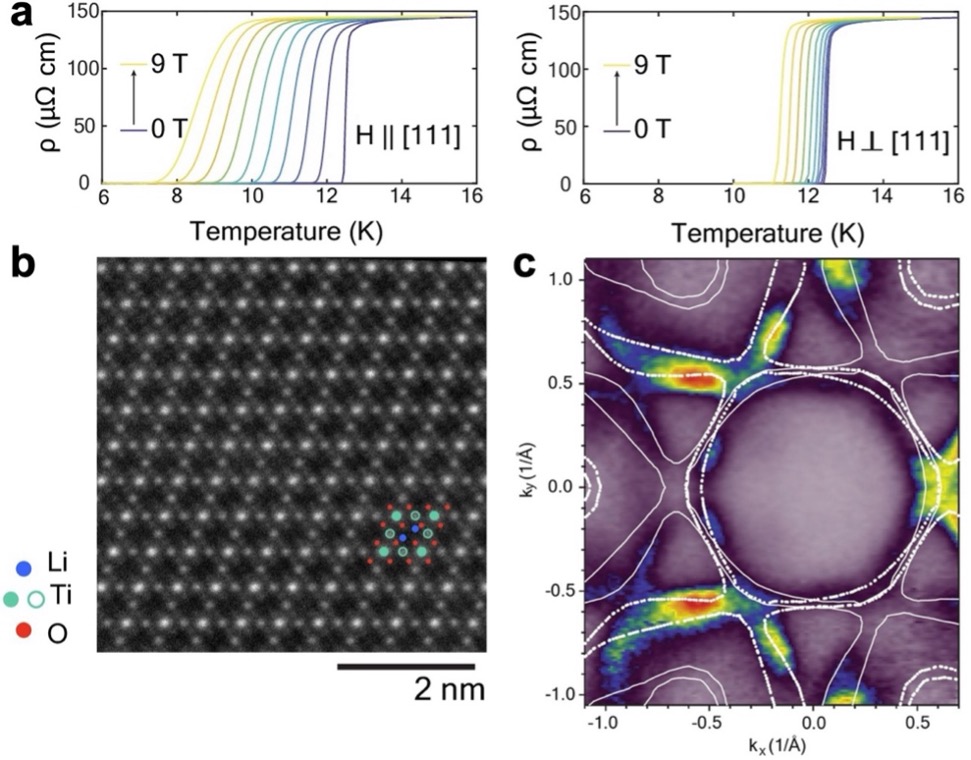
Figure 1: Figure. a) Resistivity vs. temperature curves showing the superconducting transition at ~ 12.5 K and with applied magnetic field (0 to 9 T) parallel and perpendicular to the sample. b) Electron micrograph of LiTi2O4 overlaid with the corresponding atoms. c) ARPES measured Fermi surface overlaid with DFT-calculated Fermi surface.
Until the discovery of superconductivity in the cuprates in 1986, LiTi2O4 and BaPb0.7Bi0.3O3 were the oxides with the highest known transitions temperatures, 12 K and 13 K, respectively. As LiTi2O4 does not cleave, angle-resolved photoemission spectroscopy (ARPES) had not been achieved on LiTi2O4, until now.
Here, PARADIM’s MBE+ARPES signature tool was used to synthesize thin films of superconducting LiTi2O4, enabling a detailed spectroscopic investigation using resonant inelastic x-ray scattering and ARPES for comprehensive insights of the low-energy physics of LiTi2O4. The users observe strong electronic correlations and signatures of strong electron–phonon coupling indicating a novel polaronic ground state—also found in weakly doped cuprates. Theoretical calculations (DFT) can reproduce some of the features observed by ARPES but are unable to reproduce the full interplay of both interactions. By revealing the complex correlations in LiTi2O4 the work challenges the notion of phonon-dominated BCS superconductivity in the material.
Geometrically frustrated lattices can display a range of correlated phenomena, ranging from spin frustration and charge order to dispersionless flat bands due to quantum interference. One particularly compelling family of such materials is the half-valence spinel LiB2O4 materials. On the B-site frustrated pyrochlore sublattice, the interplay of correlated metallic behavior and charge frustration leads to a superconducting state in LiTi2O4 and heavy fermion behavior in LiV2O4. To date, however, LiTi2O4 has primarily been understood as a conventional BCS superconductor despite a lattice structure that could host more exotic ground states. Here, the users present a multimodal investigation of LiTi2O4, combining ARPES, RIXS, proximate magnetic probes, and ab-initio many-body theoretical calculations. The data reveals a novel mobile polaronic ground state with spectroscopic signatures that underlie co-dominant electron-phonon coupling and electron-electron correlations also found in the lightly doped cuprates.
At the discovery of superconductivity in lithium titanate (LiTi2O4) in 1973 it was understood as a conventional BCS superconductor. Now the users show that the cooperation between electron-phonon coupling and electron-electron correlations distinguishes LiTi2O4 from other superconducting titanates, suggesting an unconventional origin to superconductivity in LiTi2O4. The work deepens the understanding of the rare interplay of electron-electron correlations and electron-phonon coupling in unconventional superconducting systems. In particular, the work identifies the geometrically frustrated, mixed-valence spinel family as an under-explored platform for discovering unconventional, correlated ground states.
This work made use of PARADIM’s signature 62-element molecular-beam epitaxy system.
Initiated by a user proposal to PARADIM lead by Prof. Julia Mundy (Harvard) and a theory collaborator, Prof. Antia Botana (Arizona State U), the study brought together members of the PARADIM In-House Research Team, beam line scientists at the Diamond Light Source, UK, the Paul Scherrer Institut (PSI) Center for Neutron and Muon Sciences, Switzerland, the Advanced Light Source, and the National Synchrotron Light Source, and further collaborators at Northeastern U, Cornell, Harvard, and NIST.
Z. Hasan, G.A. Pan, H. LaBollita, A. Kaczmarek, S.H. Sung, S. Sharma, P.P. Balakrishnan, E. Mercer, V. Bhartiya, A.T. N’Diaye, Z. Salman, T. Prokscha, A. Suter, A.J. Grutter, M. Garcia-Fernandez, K.-J. Zhou, J. Pelliciari, V. Bisogni, I. El Baggari, D.G. Schlom, M.R. Barone, C.M. Brooks, K.C. Nowack, A.S. Botana, B.D. Faeth, A. de la Torre, and J.A. Mundy, "Unconventional Polaronic Ground State in Superconducting LiTi2O4," Nat. Commun. 17, 1303 (2026).
We thank useful discussions with G. Grissonnanche, M. R. Norman, Y. Wang, F. Baumberger, and J. Sous. This research is primarily supported by the National Science Foundation, Division of Materials Research, under Award No. DMR-2339913. Materials growth and photoemission studies were supported by the Platform for the Accelerated Realization, Analysis, and Discovery of Interface Materials (PARADIM) under NSF Cooperative Agreement No. DMR-2039380. All nanofabrication work was performed at Harvard University’s Center for Nanoscale Systems (CNS), a member of the National Nanotechnology Coordinated Infrastructure Network (NNCI), supported by the National Science Foundation under NSF Grant No. 2025158. Z.H. and G.A.P. acknowledge support from the Paul & Daisy Soros Fellowship for New Americans. G.A.P. acknowledges additional support from the NSF Graduate Research Fellowship Grant No. DGE-1745303. A.K. and K.C.N. acknowledge support from the Air Force Research Laboratory, Project Grant FA95502110429. S.H.S. and I.E.B. acknowledge support from the Rowland Institute at Harvard University. J.A.M. acknowledges support from the Packard Foundation and the Sloan Foundation. This research used beamline 2-ID of the National Synchrotron Light Source II, which is a US DOE Office of Science Facility operated for the DOE Office of Science by Brookhaven National Laboratory under contract no. DE-SC0012704. HL and ASB acknowledge support from NSF Grant No. DMR-2323971. The μSR experiments were performed at the Swiss Muon Source, SμS, Paul Scherrer Institute, Villigen, Switzerland. Certain commercial equipment, instruments, software, or materials are identified in this paper in order to specify the experimental procedure adequately. Such identifications are not intended to imply recommendation or endorsement by NIST, nor are they intended to imply that the materials or equipment identified are necessarily the best available for the purpose. This research used resources of the Advanced Light Source, which is a DOE Office of Science User Facility under contract no. DE-AC02-05CH11231.