PARADIM Highlight #121—External User Project (2026)
Berit H. Goodge (Cornell, MPI Dresden), David A. Muller (Cornell), Antia S. Botana (Arizona State University), Harold Y. Hwang (Stanford), and Julia A. Mundy (Harvard)
Since the discovery of high-temperature superconductivity in copper-based oxides (cuprates), there has been a sustained effort to understand its origin and to discover new superconductors based on similar building principles. Recently, the discovery of superconductivity in bulk La3Ni2O7 under high hydrostatic pressure and biaxial compression in epitaxial thin films has ignited significant interest in understanding the interplay between atomic and electronic structure in these compounds.
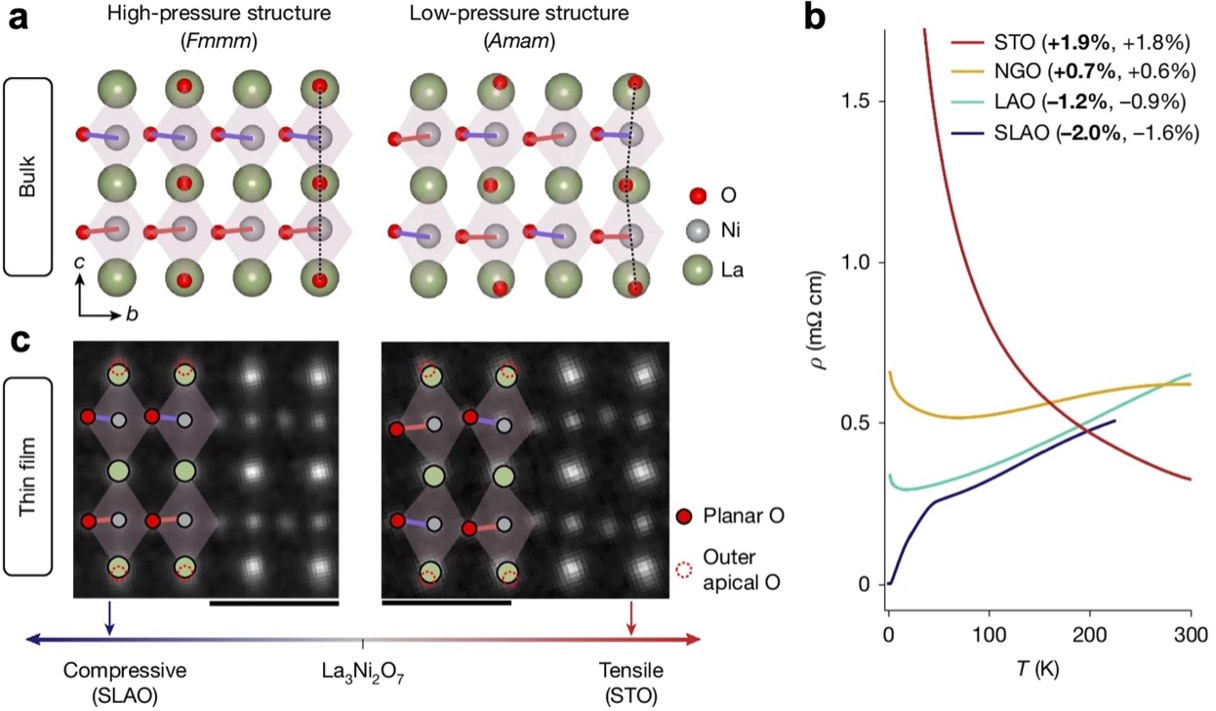
>Figure 1: Structural and electrical changes in thin films under compressive and tensile strain. a) High-pressure and low-pressure bulk structures of one bilayer. b) Resistivity ρ(T) of La3Ni2O7 thin films epitaxially strained on various substrates SLAO (blue), LAO (cyan), NGO (yellow), and STO (red); chemical formulas are given in the text. The film on SLAO shows a superconducting onset near 42 K. c) Atomic structures of La3Ni2O7 thin films under compressive (left) and tensile (right) strain measured experimentally by multislice electron ptychography.
Through PARADIM, multiple external and local users joined forces with members of the In-House Research Team to identify key structural characteristics responsible for the electronic changes observed for La3Ni2O7 thin films. Advanced electron ptychography developed in the PARADIM EM facility provides the first detailed measurements of subtle atomic distortions across a range of compressive and tensile strain.
Future thin film synthesis efforts to achieve even larger compressive strains or chemical pressures combined with low-temperature characterization will further facilitate the quest for understanding structural and electronic interplay in high-temperature superconductors.
A collaborative team of PARADIM users have run a systematic study of La3Ni2O7 thin films grown on different substrates with varying epitaxial strain, we identify essential structural characteristics responsible for electronic changes observed across the strain series. Macroscale XRD and quantitative atomic resolution ADF-STEM measurements point to the necessity of in-plane rather than c-axis compression for achieving superconductivity. Direct quantitative measurements of Ni-planar O bond angles via MEP reveal a lifting of crystalline symmetry under biaxial compressive strain which mirrors that reported in bulk crystals under high pressure conditions. Together, these call for revisiting theoretical understanding of the Fermiology in these compounds, suggesting possible cuprate-like physics rather than the prevailing hypotheses of Ni 3dz2 orbital overlap. We also identify sources of internal strain within the films and key areas for materials improvements which may lead to higher and sharper superconducting transitions. Future exploration of the structural changes tuned by even larger compressive strains, chemical pressure, and at low temperatures will further facilitate the quest for understanding structural and electronic interplay in high-temperature superconductors.
Since the discovery of high-temperature superconductivity in copper-based oxides, there have been sustained efforts to both understand the origins of this phase and discover new “cuprate-like” superconducting materials. Nickel-oxide (nickelate) materials have been a sustained target material for their chemical proximity to copper, first demonstrated as a successful superconducting platform in 2019. Since 2023, a second family of layered nickelates also demonstrated superconductivity with even higher transition temperatures (now reaching over 40 K in thin films and 90 K in bulk) which appear to be tuned by structural manipulation. Building on thin film synthesis recipes first pioneered and optimized at PARADIM (Pan et al, PRM 2022), this work stabilizes the most complete epitaxial strain series of La3Ni2O7 produced to-date, and harness advanced electron microscopy methods to visualize the distinct atomic arrangements, also for the first time.
This work made use of PARADIM’s new Thermo Fisher Spectra 300 X-CFEG electron microscope with the EMPAD G2 detector and algorithms for multislice electron ptychography. This specialized data collection and processing is the only experimental method which can reliably and accurately measure the subtle atomic distortions—in particular the oxygen atomic column displacements—which reveal the key insight of this work. Additionally, no other synthesis group has reported high-quality growth of layered nickelates across such a wide strain series: previous reports all suffer from off-stoichiometric decomposition due to the narrow thermodynamic stability of these line compounds. Our ability to stabilize thin films with high crystallinity on four different oxide substrates builds directly on growth recipes first established in the PARADIM thin film facility.
L. Bhatt, E. Abarca Morales, A.Y. Jiang, E.K. Ko, Y.-F. Zhao, N. Schnitzer, G.A. Pan, D. Ferenc Segedin, Y. Liu, Y. Yu, C.M. Brooks, A.S. Botana, H.Y. Hwang, J.A. Mundy, D.A. Muller, and B.H. Goodge, "Structural Modifications in Strain-Engineered Bilayer Nickelate Thin Films," Nature 653, 76–82 (2026), DOI: 10.1038/s41586-026-10446-2
L.B. dedicates this paper to Dr. Lena F. Kourkoutis for her continuous guidance, support, and inspiration. We thank M.R. Norman, B.Y. Wang, and Y. Tarn for useful feedback. This work made use of the Cornell Center for Materials Research shared instrumentation facility. L.B. and D.A.M. acknowledge support by the NSF Platform for the Accelerated Realization, Analysis, and Discovery of Interface Materials (PARADIM) under cooperative agreement No. DMR-2039380. The Thermo Fisher Spectra 300 X-CFEG was acquired with support from PARADIM, an NSF-MIP (DMR-2039380), and Cornell University. A.Y.J., G.A.P., D.F.S., C.M.B. and J.A.M. acknowledge support from US Department of Energy, Office of Basic Energy Sciences, Division of Materials Sciences and Engineering, under award no. DE-SC0021925. A.Y.J., G.A.P., and D.F.S. acknowledge support from the NSF Graduate Research Fellowship. G.A.P. and A.Y.J. were also supported by the Paul and Daisy Soros Fellowship for New Americans and A.Y.J. by the Ford Foundation. J.A.M. acknowledges support from a Packard Fellowship and a Sloan Fellowship. E.K.K, Y.Y, Y.L. and H.Y.H. acknowledge support from the U. S. Department of Energy, Office of Basic Energy Sciences, Division of Materials Sciences and Engineering (Contract No. DE-AC02-76SF00515) and the Gordon and Betty Moore Foundation’s Emergent Phenomena in Quantum Systems Initiative (grant no. GBMF9072, synthesis equipment). Part of the sample fabrication was conducted at the Stanford Nano Shared Facilities (SNSF), supported by the National Science Foundation under grant ECCS-1542152. Y.-F.Z. acknowledges support from NSF Grant No. DMR-2323971. A.S.B. was supported by the Alfred P. Sloan Foundation (FG-2022-19086). E.A.M. and B.H.G. were supported by the Max Planck Society. B.H.G. was additionally supported by Schmidt Science Fellows in partnership with the Rhodes Trust.