PARADIM Highlight #113—External User Project (2025)
Harold Y. Hwang (Stanford) and David A. Muller (Cornell)
Superconductivity is the ability of certain materials to conduct electricity with zero resistance. Though technologically promising, stabilizing superconductivity requires extremely low temperatures or extremely high pressures – constraints which not only impede applications but also limit fundamental research.
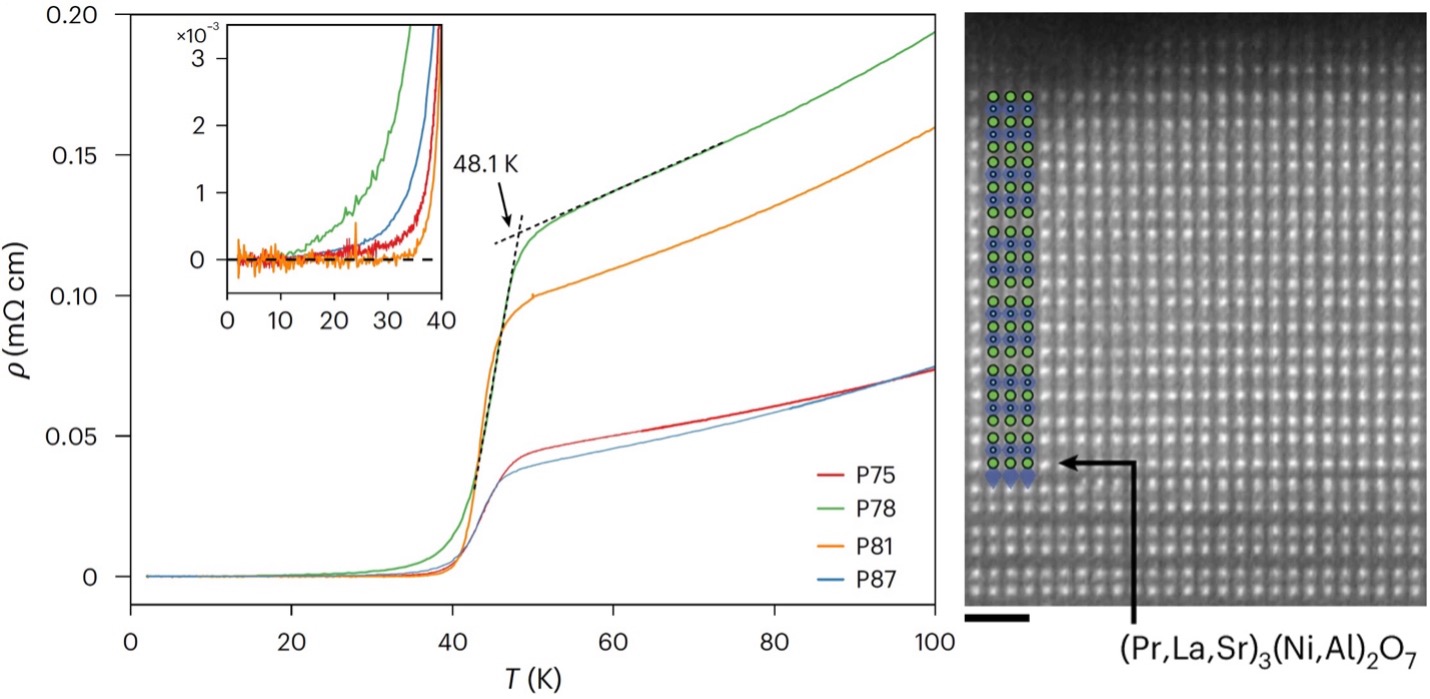
Figure 1: Superconductivity in thin-film La2PrNi2O7. Left) Resistivity vs. temperature curves of several compressively strained thin films and onset of the zero-resistance state (inset). Right) Scanning transmission electron micrograph showing the layered atomic structure of a La2PrNi2O7 film and the SrLaAlO4 substrate. Scale bar 1 nm.
A new family of nickel-based superconductors achieve relatively high superconducting temperatures under high pressures. Instead of applying external pressure, a team at Stanford used thin-film growth techniques to impart lateral compression on thin films deposited atomic layer by atomic layer, conforming the crystalline lattice to a substrate and stabilizing superconductivity in La3Ni2O7 at ambient pressure for the first time. Now, by fine-tuning the films with praseodymium substitution, growth optimization, and precision sample annealing, they achieve super-conductivity in films at 1 atm at temperatures comparable to those which require more than 100,000 atm in bulk samples.
PARADIM’s capabilities in high-resolution electron microscopy provided the team with insights to the thin film-substrate interface, the role of defects, and the impact of the oxygen content in the nickelate films.
The discovery of superconductivity under high pressure in Ruddlesden–Popper phases of bulk nickelates has sparked great interest in stabilizing ambient-pressure superconductivity in the thin-film form using epitaxial strain. Recently, signs of superconductivity have been observed in compressively strained bilayer nickelate thin films with an onset temperature exceeding 40 K, although with broad, two-step-like transitions. Here we report the intrinsic superconductivity and normal-state transport properties in compressively strained La2PrNi2O7 thin films, achieved through a combination of isovalent Pr substitution, growth optimization and precision ozone annealing. The superconducting onset occurs above 48 K, with zero resistance reached above 30 K, and the critical current density at 1.4 K is 100-fold larger than previous reports. The normal-state resistivity exhibits quadratic temperature dependence indicative of Fermi liquid behavior, and other phenomenological similarities to transport in overdoped cuprates suggest parallels in their emergent properties.
This work demonstrates significant improvement in the sample quality and functional materials properties of superconducting bilayer nickelate films, highlighting their promise as a rapidly emerging material system of interest and offering new insights to their intrinsic properties. Systematic optimization of the post-growth annealing conditions provide a roadmap for other groups in the field, clarifying the both importance of and route to finely tuned oxygen stoichiometry. Detailed investigations of the atomic structure at the film-substrate interface also shed light on open questions of where superconductivity occurs in these samples, suggesting that it is not limited to specific electronic conditions which occur only at certain interfaces but is rather “hosted” throughout larger regions in the film. Comparing the properties of these films with copper-oxide compounds also point to possible commonalities which may help establish more universal understanding and prediction of high-temperature superconductivity.
Atomic-resolution imaging in PARADIM’s EM facility confirm the overall improved sample quality in optimized films, while also revealing remaining local deviations from the intended crystal structure that may contribute spurious signals in film-averaged properties measurements. Given their sensitivity to oxygen content, specimens required careful sample preparation in PARADIM’s focused ion beam (FIB) and STEM measurements with relatively low electron doses enabled by the high-brightness source and improved electron optics of the TFS Spectra 300 X-CFEG STEM.
Y. Liu, E.K. Ko, Y. Tarn, L. Bhatt, J. Li, V. Thampy, B.H. Goodge, D.A. Muller, S. Raghu, Y. Yu, and H.Y. Hwang, "Superconductivity and Normal-State Transport in Compressively Strained La2PrNi2O7 Thin Films," Nat. Mater. 24, 1221–1227 (2025).
We thank Y. Deng, K. Lee, Y. Lee, Y. Lv, J. May-Mann, F. Theuss, B. Y. Wang, Y.-M. Wu and J. J. Yu for discussions and assistance. Y.L., E.K.K., Y.T., J.L., S.R., Y.Y. and H.Y.H. acknowledge support from the US Department of Energy, Office of Basic Energy Sciences, Division of Materials Sciences and Engineering (contract no. DE-AC02-76SF00515), as well as SuperC and the Kavli Foundation (aspects of magnetic characterization). Work at the Stanford Nano Shared Facilities (SNSF) RRID:SCR_023230 is supported by the National Science Foundation under grant ECCS-1542152. L.B. and D.A.M. acknowledge support from the National Science Foundation (DMR-1719875), NSF PARADIM (DMR-2039380) and the Weill Institute and the Kavli Institute at Cornell University. X-ray measurements were carried out at the SSRL, SLAC National Accelerator Laboratory, supported by the US Department of Energy, Office of Science, Office of Basic Energy Sciences (contract no. DE-AC02-76SF00515). B.H.G. acknowledges support from the Max Planck Society and Schmidt Science Fellows in partnership with the Rhodes Trust.